Shri Vile Parle Kelavani Mandal’s
Pravin Gandhi College of Law
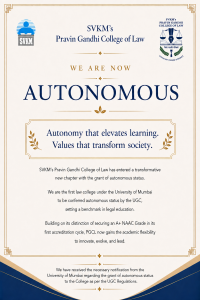
- [AUTONOMOUS]
- Accredited ‘A+’ Grade (3.28 CGPA) by NAAC
- Approved by Bar Council of India (BCI)
- Permanently affiliated to the University of Mumbai AISHE Code: C-33901
Shri Vile Parle Kelavani Mandal’s
Pravin Gandhi College of Law

Shri Vile Parle Kelavani Mandal (SVKM) is a Public Charitable Trust registered under the Societies Registration Act, 1860 and The Bombay Public Trusts Act, 1950. SVKM has always been committed to the cause of providing high quality education at various levels. From its humble beginnings in 1934, when it adopted the Rashtriya Shala, a school established in 1921 in the wake of the National Movement; the Mandal today has grown into a large educational enterprise imparting high-level education across India.
The ethos of the Mandal, is marked by patriotic fervour, selfless service and the spirit of indigenous enterprise, has its genesis in the days of India’s struggle for freedom.
SVKM’s Pravin Gandhi College of Law (PGCL), established in 2004, is permanently affiliated to the University of Mumbai and offers a comprehensive five-year integrated law program – B.A./LL. B., Master of Laws (LL.M.), and Post Graduate Diploma in Cyber Laws and Information Technology. The college is under the aegis of India’s leading public charitable trust, Shri Vile Parle Kelavani Mandal, committed to excellence in education. Reaffirming our dedication to academic excellence, the institution has been accredited in the first cycle of NAAC (National Assessment and Accreditation Council) with a CGPA of 3.28 on a four-point scale, earning an A+ Grade.
As an affiliated college, the institution emphasises a curriculum that integrates a strong theoretical foundation with practical application. In addition, the college strives to incorporate an interdisciplinary approach by meaningfully combining law courses with social sciences and humanities. To achieve the college’s vision for the holistic development of graduates, the college organises a range of academic and co-curricular activities at both intra-college and inter-college levels. Distinguished professionals and experts from various fields are regularly invited to share insights on contemporary legal and industry-related issues, thereby fostering an industry-academia interface and enhancing students’ practical understanding. In line with our commitment to developing students’ critical thinking and problem-solving abilities, PGCL conducts various simulation exercises and experiential learning activities. This blended approach—combining contextualised teaching methodologies with real-world exposure—enables students to consolidate their academic knowledge while acquiring essential practical skills.
A distinctive feature of the institution is its YES – Year-Round Capability Enhancement Skills Sessions, conducted every Friday. These sessions focus on holistic student development through value-added courses such as debating skills, critical thinking, Marathi language proficiency, mental well-being, Alternative Dispute Resolution (ADR), legal research and writing, public speaking, negotiation skills, and emerging areas of law such as Cyber law and Intellectual Property Rights, AI Governance, Maritime Law, Media & Entertainment Law, Financials & Forensics. This continuous engagement ensures that students build competencies beyond the prescribed syllabus.
Student-moderated discussions on contemporary issues and judgments are among our initiatives to inculcate research acumen and team spirit, among others. The Legal Aid Committee exemplifies the institution’s commitment to social responsibility, encouraging students to actively engage with community issues and access to justice. The college provides online and print platforms (The Briefcase – a monthly legal newsletter) for students’ research publications, enabling them to reach a wider audience and connect with fellow researchers worldwide. Our students’ outstanding achievements in research paper writing competitions at both national and international levels bear testimony to our commitment to enhancing our students’ legal research skills. Furthermore, the craft of creative expressions, storytelling, and critical reading – essential tools for advocacy – is nurtured and encouraged through the bimonthly and annual multilingual literary magazines (L’avocat).
Equally significant is the college’s dynamic and innovative pedagogy. Teaching-learning practices go beyond conventional lectures to include interactive sessions, case-based learning, moot court simulations, role plays, group discussions, flipped classrooms, experiential learning modules, and project-based assignments. We also emphasise experiential learning through moot courts, internships, legal aid initiatives, debates, and workshops.
With a dedicated faculty, modern infrastructure, and a learner-centric environment, Pravin Gandhi College of Law aims to create professionals who are not only competent lawyers but also ethical and socially conscious global citizens rooted in local ethos and traditions. Our consistent focus on quality education and all-around development makes the college a preferred destination for aspiring law students. At Pravin Gandhi College of Law, education extends beyond the classroom, shaping individuals prepared to contribute thoughtfully and responsibly to the legal profession and society at large.

To be a pioneering centre of legal education, fostering ethical minds committed to social justice, integrity and sustainability.

PGCL: Progressively spearheading research and teaching.
The interactive teaching methods are designed to aid comprehension and retention and aid for a lifetime. Our focus is to train the student to think and act from the very inception with a legal mind, acquiring lawyering skills for varied legal services in the modern world. The teaching methods provide rapid socialization into the standards of legal thinking and blends training with knowledge management.
“The only source of knowledge is experience.”
– Albert Einstine